CLINICAL THINKING TYPE
Premature Closer
You decide quickly under pressure —
but early certainty can stop reassessment
Free mini playbook · 3-minute read · Instant access
YOUR CLINICAL STRENGTHS

WHERE THINGS GET MISSED
Early closure becomes dangerous when:
the first explanation feels “good enough”
contradictory information is minimised
reassessment quietly stops
The danger is rarely lack of knowledge.
It is committing before the full clinical picture has emerged.
Under pressure, premature closers may:
stop reopening the differential diagnosis
anchor strongly to early impressions
unconsciously filter conflicting evidence
continue a pathway that no longer fit

The danger is not making decisions quickly.
It is stopping the diagnostic search too early.
The best clinicians stay decisive — while continuously challenging their assumptions.
CLINICAL SNAPSHOT

A 58-year-old patient presents with epigastric pain and vomiting. Initial observations are stable.
The presentation appears consistent with gastritis or reflux.
You rapidly recognise a familiar pattern.
Your instinct says:
“This is probably benign upper GI irritation.”
You begin treatment and discharge planning.
But one contradiction appears:
worsening diaphoresis
subtle hypotension
pain radiating to the back
The original diagnosis still feels right.
Under pressure, early certainty can quietly stop reassessment.
This is how serious diagnoses are missed:
not through lack of knowledge —
but through diagnostic fixation.
The danger is not confidence.
It is confidence that stops re-evaluation.
THE RADIAL LOOP
A repeatable system for clinical decision-making under pressure
Most clinicians already have the knowledge.
The challenge is applying it clearly under pressure —
when information is incomplete,
priorities compete,
and situations evolve quickly.
RADIAL is a structured clinical thinking loop designed to reduce cognitive drift during real patient care.
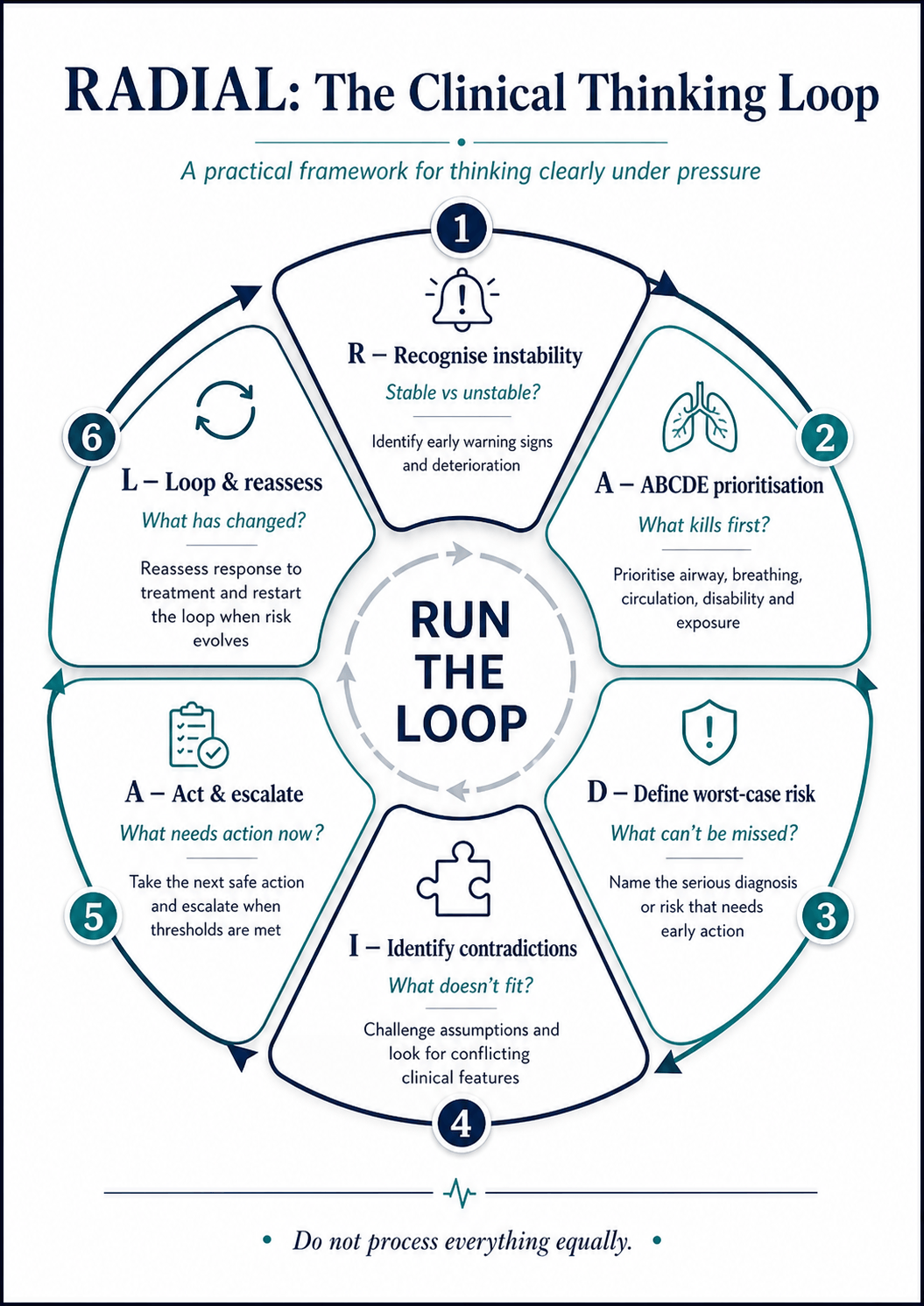
RADIAL is not a checklist.
It is a thinking structure.
Built from real emergency medicine decision-making patterns.
Designed for clinicians in emergency, urgent and prehospital care
EARLY ACCESS
Think like and Emergency Clinician under pressure
A practical clinical reasoning framework for acute decisoin-making
Most clinicians do not struggle because they lack knowledge.
They struggle because:
• pressure distorts prioritisation
• uncertainty delays escalation
• intuition overrides verification
• reassessment stops too early
RADIAL provides a repeatable structure for thinking clearly under pressure.
Built from real emergency medicine decision-making patterns.
Designed for clinicians working in uncertainty, prioritisation and escalation under pressure.
WHAT YOU GET
Included in your early access:

The Full RADIAL Framework
A repeatable structure for clinical decision-making under pressure.
Clinical Failure Patterns
Understand overload, hesitation and premature closure in real care.

Micro-Scenarios
Short realistic cases showing how cognitive drift develops.

Practical Shift Tools
Mental prompts and decision structures usable on your next shift.
systeme.io
systeme.io
Create Your Free Account