CLINICAL THINKING TYPE
Overloaded Processor
You process information deeply — but too many possibilities can delay prioritisation.
Free mini playbook · 3-minute read · Instant access
YOUR CLINICAL STRENGTHS

Broad information awareness
You notice details, variables and competing possibilities others may overlook.

Careful differential thinking
You naturally consider multiple explanations before committing too early.

Risk-sensitive decision-making
You are less likely to ignore uncertainty or oversimplify unstable situations.
WHERE THINGS GET MISSED
Over-analysis becomes dangerous when:
every possibility feels equally important
prioritisation slows
uncertainty delays escalation
The danger is rarely lack of knowledge.
It is difficulty simplifying the situation quickly enough to prioritise decisively.
Under pressure, overloaded clinicians may:
continue gathering information after thresholds are met
struggle to narrow priorities
delay escalation while seeking certainty
lose momentum in rapidly evolving situations

The danger is not missing information.
It is failing to simplify it quickly enough.
The best clinicians simplify complexity early while reassessing continuously.
CLINICAL SNAPSHOT

A 74-year-old patient presents with sepsis and increasing confusion.Observations are concerning but not catastrophic.
There are multiple abnormal findings:
borderline blood pressure
rising respiratory rate
elevated lactate
new confusion
poor urine output
You begin analysing every variable carefully.
You review the bloods again.
You reconsider the differential diagnosis.
You continue gathering more information.
But while processing complexity:
escalation is delayed
priorities become blurred
treatment momentum slows
Under pressure, overloaded thinking can make every problem feel equally urgent.
This is how deterioration gets missed:
not through lack of knowledge —
but through delayed prioritisation.
The danger is not missing detail.
It is losing momentum inside complexity.
THE RADIAL LOOP
A repeatable system for clinical decision-making under pressure
Most clinicians already have the knowledge.
The challenge is applying it clearly under pressure —
when information is incomplete,
priorities compete,
and situations evolve quickly.
RADIAL is a structured clinical thinking loop designed to reduce cognitive drift during real patient care.
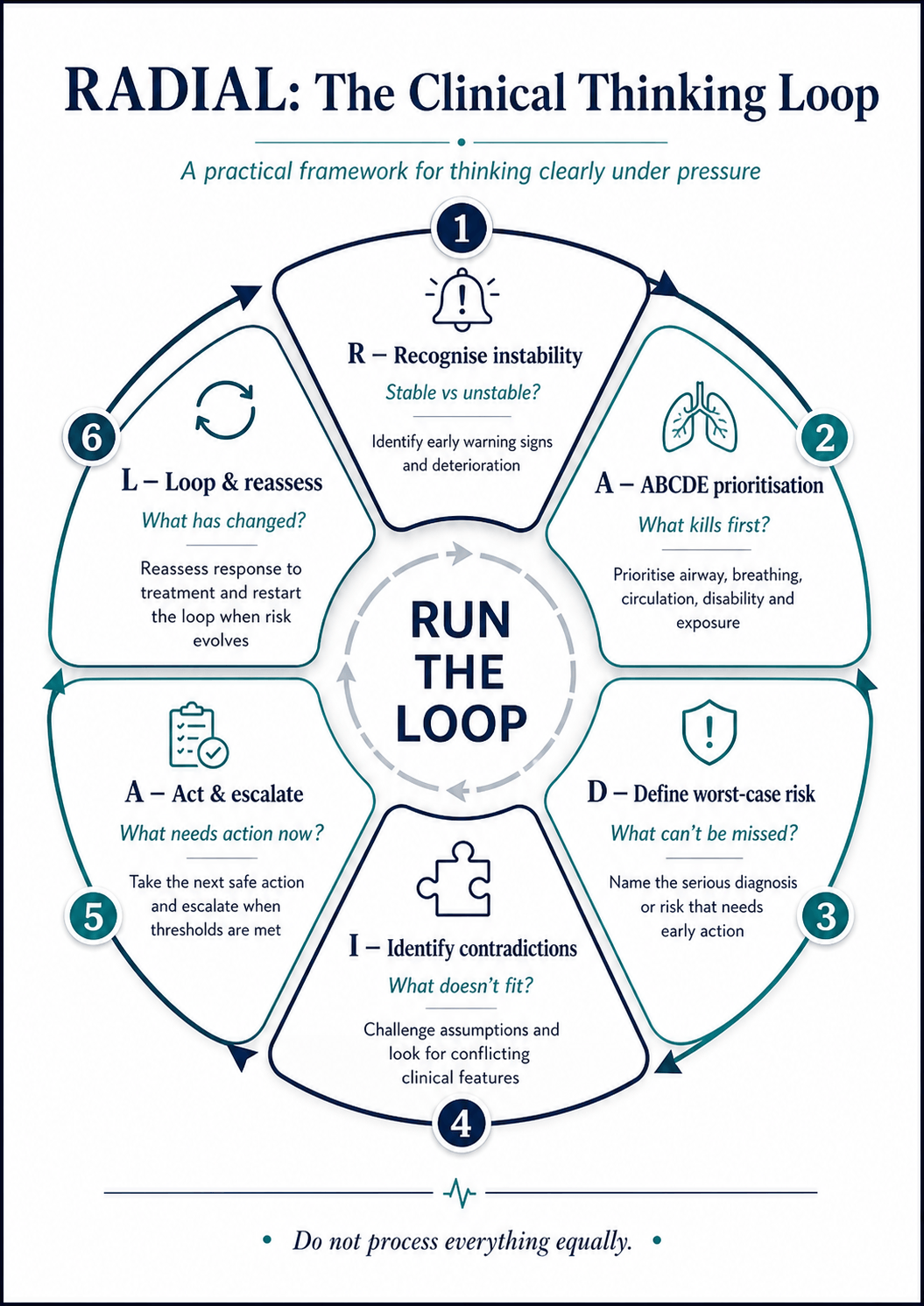
RADIAL is not a checklist.
It is a thinking structure.
Built from real emergency medicine decision-making patterns.
Designed for clinicians in emergency, urgent and prehospital care
EARLY ACCESS
Think like and Emergency Clinician under pressure
A practical clinical reasoning framework for acute decisoin-making
Most clinicians do not struggle because they lack knowledge.
They struggle because:
• pressure distorts prioritisation
• uncertainty delays escalation
• intuition overrides verification
• reassessment stops too early
RADIAL provides a repeatable structure for thinking clearly under pressure.
Built from real emergency medicine decision-making patterns.
Designed for clinicians working in uncertainty, prioritisation and escalation under pressure.

WHAT YOU GET
Included in your early access:

The Full RADIAL Framework
A repeatable structure for clinical decision-making under pressure.
Clinical Failure Patterns
Understand overload, hesitation and premature closure in real care.

Micro-Scenarios
Short realistic cases showing how cognitive drift develops.

Practical Shift Tools
Mental prompts and decision structures usable on your next shift.
systeme.io
systeme.io
Create Your Free Account